One could not pick a
better phrase than Sub-rosa to describe the activities
of mysterious Greek entrepreneur "Andreas Andrianos."
The phrase, translated as "under the rose" is used in
English to denote secrecy or confidentiality and has
mystical roots tracing back to ancient times.
The rose
was the emblem of god Horus in ancient Egypt, later
regarded by the Greeks and Romans as the god of silence.
Silence however, many concluded, would be the final fate of Andrianos'
much claimed "Project 1221", a very optimistic supercar
proposal powered
by state-of-the-art gas turbine technology. Indeed, many regarded the
project as nothing more than mythology.
When word first
circulated about the project in late 2004, news was
quick to spread. The project presented a refreshing
concept, and promised engineering and design input from
automotive engineering guru Mauro Forghieri and
ex-Pininfarina designer Emanuele Nicosia. A new
experience in luxury transport was proposed by the firm,
whilst a new land-speed production car record was also
on the list of targets; a target that the company
claimed would be set on a public road by an unskilled
driver.
A company was
registered in London and incorporated on November 1st
2004 for all intents and purposes related to the
project. Shortly after, in June 2006, news emerged from
the Paris Le Bourget Air Show revealing the type of
power plant to be used as a gas-turbine unit. Briefly it
even appeared as though Williams International would
supply the units, with a press release appearing on
their website. BBC journalist Richard Hammond's high
profile accident in a jet-powered dragster coincided
with a turning point in the project, with Williams
International pulling out of the deal. It is rumoured by
industry insiders that management got cold feet after
the crash and had lost desire to be involved in a jet
car project. Indeed, with benchmark speeds in excess of
400 km/h, and a record power to weight ratio of 1:1 this
would be a seriously fast car.
1221 Management UK Ltd
was dissolved on 6th August 2008, although company
accounts show that this company had been dormant since
at least November 2005. Indeed, it is likely that the
London based company was used as no more than a name
plate. Dust settled and thickened on the project, at
least in the minds of the motoring press.
Fresh evidence
acquired by Italiaspeed shines light on a
possible future to the project and proves that it was
indeed more than a random number. Andrianos has teamed
up with Ukranian engineer Iaishnikov Vitalii, and the
duo have successfully developed several designs relating
to gas turbine technology which have now been patented.
One such application was published earlier this year and
provides an insight as to the likely technical
specification of the MF1 supercar.
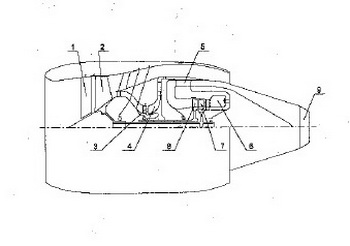
The design depicts a
turbine-axial engine, featuring a high-pressure turbine
as the "power turbine" and a low-pressure turbine used
to propel an an electric hybrid propulsion system. The
high-pressure and low-pressure turbines have inverse
rotational direction. Power to the supercars' wheels is
provided through a shaft from the high-pressure turbine
via a transmission unit. The low-pressure turbine in
turn is connected to an electric generator, which
provides power to the vehicles wheels in sequel through
electric engines. The modern hybrid design reveals the
solution to the problem of power delivery lag, which
haunted gas turbine applications to cars decades ago and
forced engineers to abandon the idea. Indeed, for low
speed use, propulsion from electric motors is effective
and easily controllable.
As many large premium
segment industry players, including Jaguar, Ferrari,
Audi, and Rolls Royce, are announcing plans to launch
innovative hybrid/electric luxury cars to the market in
the future, the momentum is starting to turn to Project
1221 and it could yet reappear from under the rose.
by Jon Medley